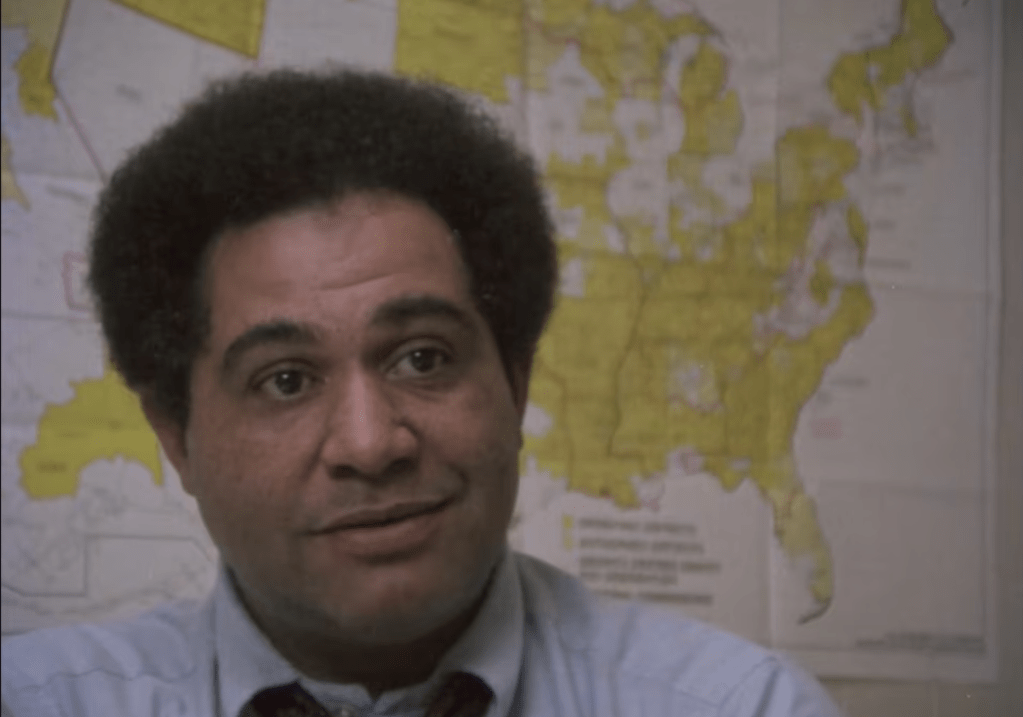
Doing some data entry and came across Reverend Harry J. Bowie for the 100th time. So decided to do a blog post highlighting this civil rights veteran.
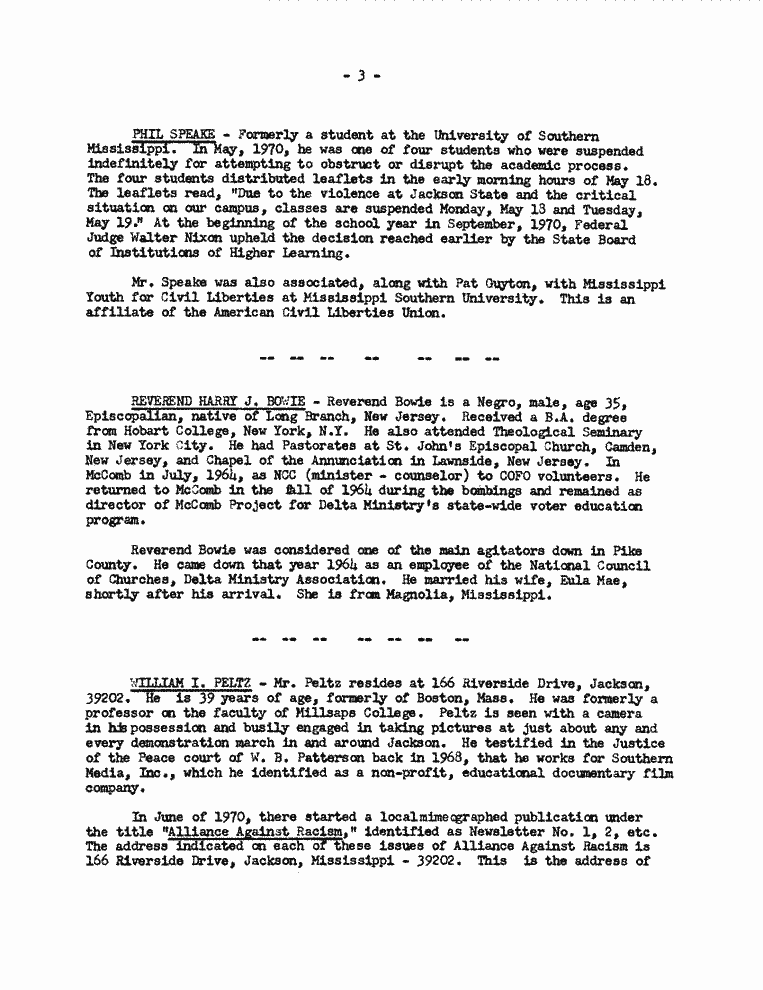
Mississippi State Sovereignty Commission, “Profiles of Various Organizations,” 1970s, SCR# 99-205-0-2-3-1-1, Mississippi Department of Archives and History.
“A Black Episcopal priest from New Jersey who came to Mississippi in 1964 with the National Council for Churches.”
B.A. Hobart College (New York)
MDiv General Theological Seminary in New York City
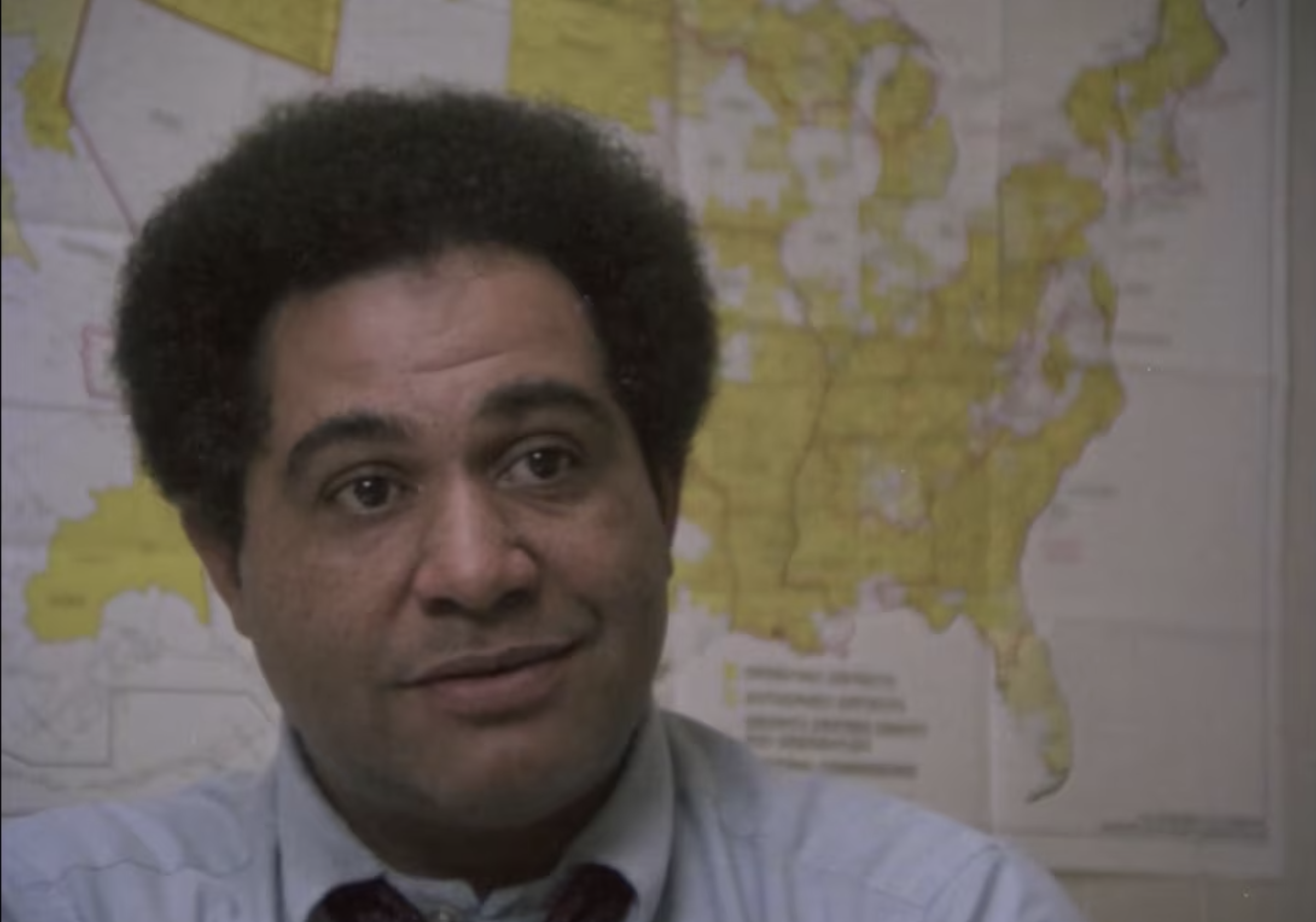
The above statement serves as the typical description writers use when introducing Rev. Harry J. Bowie (1935-2006). I was immediately interested in writing about Rev. Bowie because he was a Black Episcopal priest who came down to Mississippi, joining the wave of volunteers participating in Freedom Summer. Although a large number of ministers arrived through the National Council of Churches, the reverend began organizing in the southern state as a COFO volunteer, unaffiliated with any group. But I was also curious about the man whom the state’s Sovereignty Commission labeled as “one of the main agitators down in Pike County.”
In spring 1964, Rev. Bowie took a group of young people from his church in Long Branch, New Jersey, to a symposium at Howard University. It is a symposium that often goes unnamed…I still don’t know the name…and attendees usually recall the voices of leaders like Gloria Richardson, Stokely Carmichael (Kwame Toure), among many others. Yet, Bowie mentions SNCC activist and member of the Nonviolent Action Group (NAG), Jean Wheeler. Wheeler talked about the upcoming Freedom Summer campaign and the troubles SNCC activists and local people faced in the Deep South. Her words moved Rev. Bowie and his group, who all pledged to join the Mississippi Movement. Of this group, the priest was the only one who went to the state.
That March, Rev. Bowie wrote to Robert “Bob” Moses. He shared, “I have a month, possibly a little more time can be arranged, to give for this very important work.” As someone reviewing hundreds of Freedom Summer applications and letters, he stands out because he included a paragraph in this same letter explaining why he wanted to join the Mississippi Movement. It read:
“Reason for wanting to participate in the program I could imagine that the fact that I am a Negro is sufficient reason for wanting to be involved in this work; however, there are and should be other reasons which go along with the recognition that one is involved simply because he is Negro. Most important of the reasons which I will advance is the simple fact that I have a “stake” in what happens in Mississippi or any other part of this country. What happens to another Negro in any other section of the country affects me. I imagine that I also have some altruistic notions about helping those who are in need of help, but this would be a part of a greater feeling of my involvement because of my ‘Negroness.’”
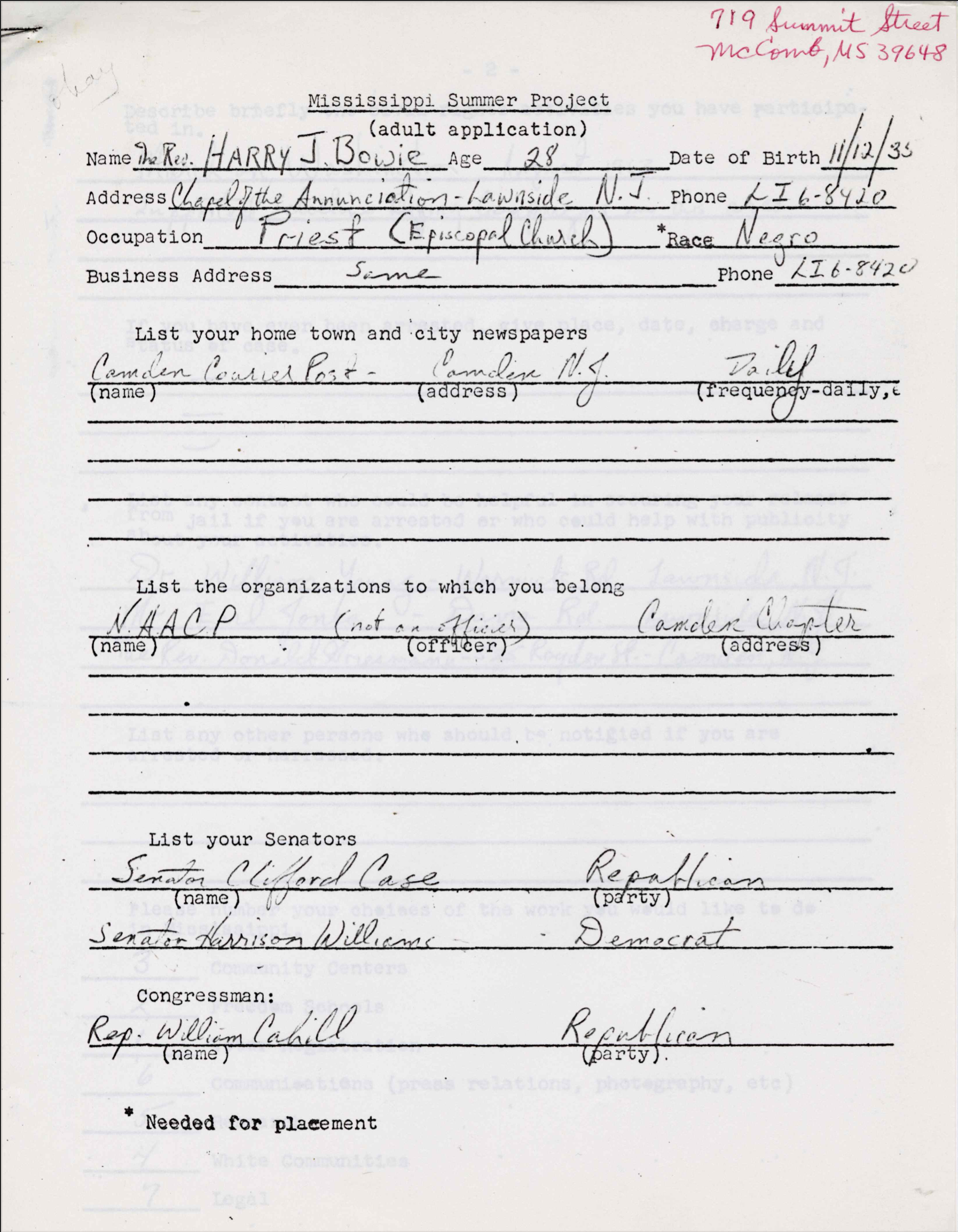
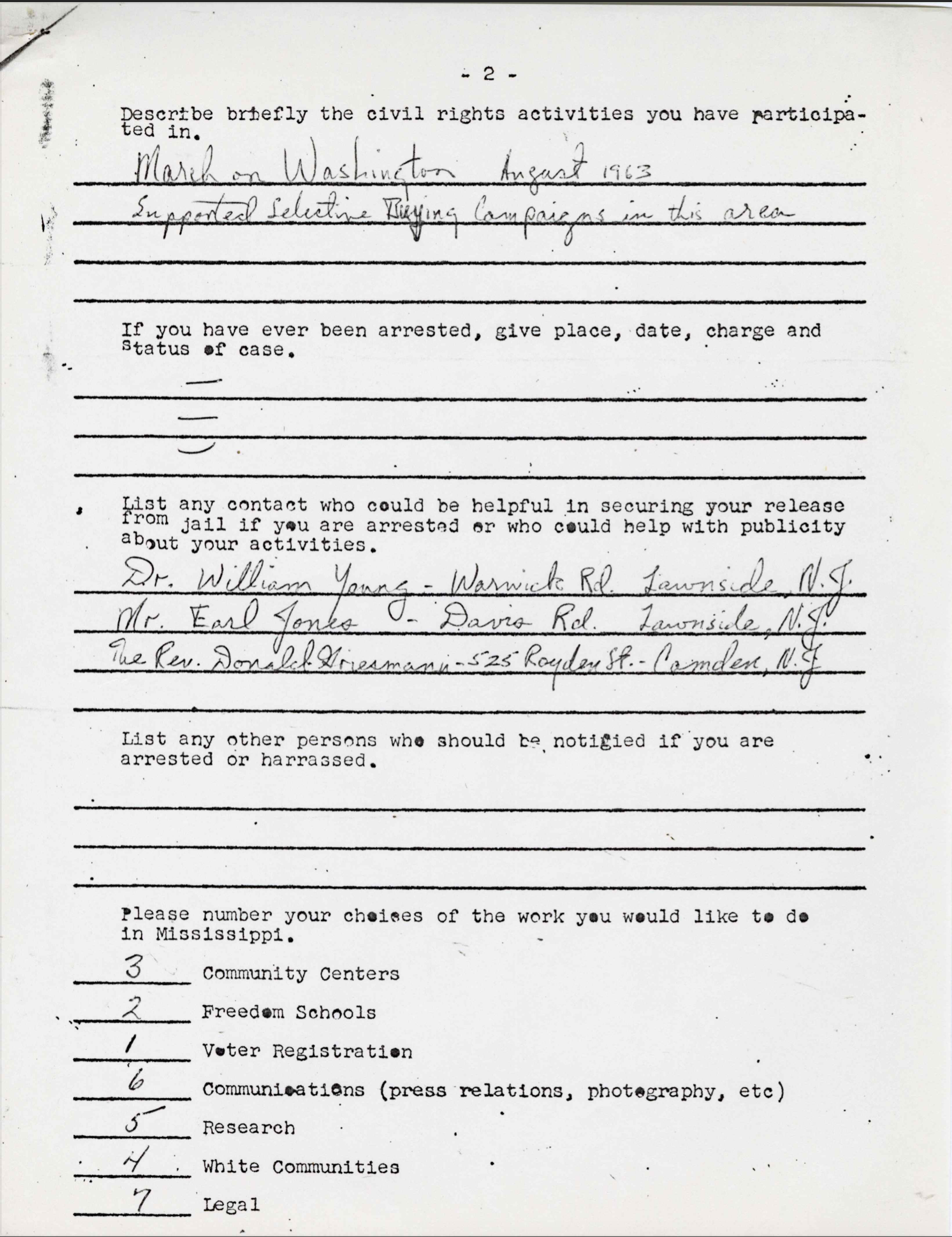
Rev. Harry J. Bowie’s Freedom Summer Application (Adult Application), 1964, Freedom Information Service Library
That July, Rev. Bowie headed to Memphis, an ongoing orientation site, where leaders asked him to join the National Council of Churches as a minister-counselor. The NCC began organizing in Mississippi following the tragic murder of Medgar Evers in June 1963 and recruited volunteers for various civil rights campaigns at the request of Bob Moses. For Freedom Summer, the organization brought in over 200 ministers and laypeople to support the Mississippi Freedom Democratic Party, Freedom Schools, community centers, and voter registration efforts.
COFO first assigned Rev. Bowie to Vicksburg, but leaders immediately directed him to the city of McComb, ground zero for SNCC’s operations in the state. He arrived in the city on July 6, 1964. Why McComb? A new wave of violence poured into the town in 1964 with repeated attacks of arson and bombing against Black churches. In July, white attackers bombed/set fire to the local COFO office, Zion Hill Free Baptist Church, Sweet Home Baptist Missionary Church, and Mount Vernon Missionary Baptist Church. Other churches had been damaged earlier that year, with no plans to reopen soon. In his role as minister-counselor, Rev. Bowie came to McComb to help churches resume their roles as a meeting space for the Movement. He planned to remain for a month, but stayed for two months, later returning to Mississippi.
[Click to read] Excerpt 1 from “Harry Bowie,” in Howell Raines, My Soul is Rested: The Story of the Civil Rights Movement in the Deep South (New York: Penguin Books: 1983), 282.
“Curtis Hayes and myself were going out to the country to get a key to an apartment in the projects in McComb…We were going to have to house some people, and we didn’t have enough room in the Freedom House…I guess it was the silliness that kind of makes it stick out. Curtis was kidding me about my Northern accent and not knowing the “survival kit” and my ability to say “yassuh.” And so I’d say, “Oh, is this the way you say ‘yes sir?’” And he’d say, “No, no.”
[Click to read] Excerpt 2 from “Harry Bowie,” in Howell Raines, My Soul is Rested: The Story of the Civil Rights Movement in the Deep South (New York: Penguin Books: 1983), 282.
“We were just laughing and joking about that kind of silly thing, and all of a sudden—we’re on this dirt road—a car passed us…There’s a car in front of us, then a second car in front of us, and a car behind us. Curtis said, “Hey, something’s wrong. There shouldn’t be this much traffic on this road.” Wheels out to try and pass the two cars, and just as he wheels out, the first car…peels off also. So they got both sides of the road blocked, and they are kind of slowing down, and Curtis had enough sense not to slow down. Okay?”
[Click to read] Excerpt 3 from “Harry Bowie,” in Howell Raines, My Soul is Rested: The Story of the Civil Rights Movement in the Deep South (New York: Penguin Books: 1983), 282.
“He said, “Harry, I’m worried.” At that point, we broke into laughter because I said, “Yas-suh.” [Laughs] And as we were laughing, I’ll never forget, he or myself—I don’t know who said it—said, “I’ll bet Schwerner, and Chaney and Goodman were laughing when they were being chased, too.” And the laughter was hysterical…we couldn’t do anything but laugh. Okay?…Curtis was a hell of a good driver. A lot of those cats were. Curtis pulled out one time…and told me to hold on, and when the other car started back in, he spun right back out, went down on the shoulder of the road, got around and took his ass off on that road about seventy. We don’t know who they were. Hell, they might have been cops that wanted to question us. We don’t know, but we weren’t going to stop to find out, not on that road.”
As a volunteer, COFO assigned each individual a specific area. Rev. Bowie worked in Whitetown and talked to residents about the Freedom Schools and voter registration, especially working with the MFDP. But most importantly, his work involved making connections with the community, addressing their issues and fears. Bowie also secured a space for the local Freedom School, which had an enrollment of more than 100.
At the summer’s end, Rev. Bowie had returned to New Jersey to continue his full-time pastoral duties. While up North, white attackers launched a series of bombings in McComb. There were six bombings in three days that September, including the home church of local activist Aylene Quinn. This act of violence called Rev. Bowie back to Mississippi for at least a month. He remained in the state, becoming an essential member of the Delta Ministry staff and working on the county’s Freedom Vote campaign, or mock elections in support of the MFDP. Rev. Bowie also played a key role in establishing centers in McComb. He assigned about sixteen NCC/Delta Ministry volunteers to work at the Child Development Group of Mississippi centers.
Rev. Bowie continued to organize in Mississippi and passed away in Jackson in 2006.
“We came to Mississippi because of the power of what we believed. We were ordinary people, and coming together for what we believed in, we became extraordinary.”
— Harry Bowie at the SNCC reunion, undated.
 Diary of a Historian

Leave a comment