I published an article last fall with Gender & History’s special issue on gender and segregation. You can read it for free. Let me know what you think.
An Excerpt—
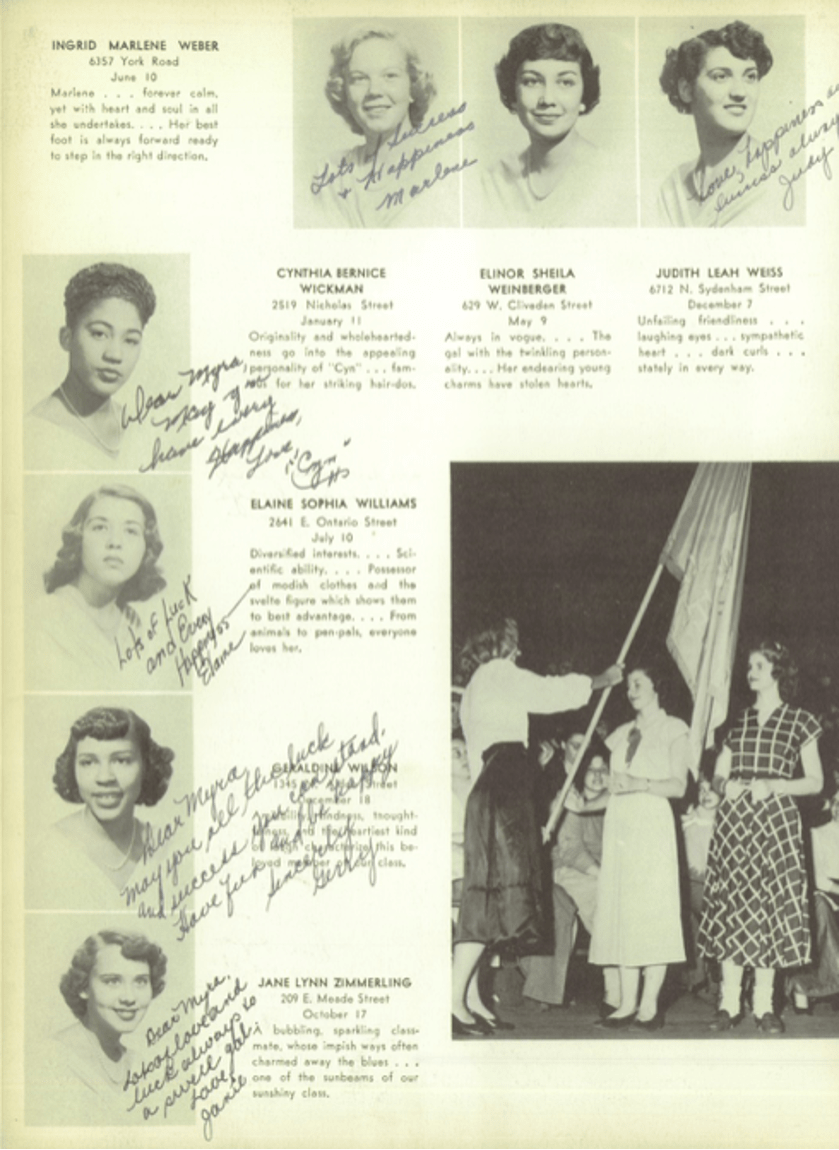
In the fall of 1949, seventeen-year-old Geraldine Louise Wilson posed for her senior photograph as a midwinter graduate at Philadelphia High School for Girls, known to her as Girls’ High (see figure below). After four years of study at this prestigious institution, this portrait represented a rite of passage for all soon-to-be graduates of class number 178. Decades later, in 1982, a fifty-one-year-old Wilson reflected on this accomplishment through poetry. In the opening excerpt of ‘High School Portrait’, she recalled someone adorning her with the classic light-coloured velvet drape and a string of pearls. Perhaps a slight readjustment, as Wilson was careful not to ruin her curls. She remembered waiting for the photographer to pose her – gaze to the right, gaze to the left and now look into the camera – an almost smile for a proud family. Such language provides a gateway into Wilson’s schoolgirl years within Philadelphia’s public schools during the 1930s and 1940s.
When Wilson wrote this poem, scholars of education recognized her as one of the leading voices in early Black childhood education, given her contributions to Head Start programmes nationwide. Her career with the antipoverty programme started in 1966 at New York City’s Head Start Office, where she served as a field adviser responsible for training staff and supervising centres. Within seven years, Wilson advanced to the role of Project Director of the Regional Training Office, developing training programmes and resource materials across the city’s five boroughs. Beyond her work in the urban North, Wilson collaborated extensively with Head Start organizations in the South as a child development and Black history consultant, facilitating workshops addressing the cultural needs of staff and students. Throughout her career as a university educator and consultant, she mentored a new generation of educators and broadened her educational activism to include diversifying children’s literature. Wilson served on the boards of organizations such as the Council on Interracial Books for Children, the National Black Child Development Institute (NBCDI), and the Black Early Childhood Group of New York City. A year after her death in 1986, the NBCDI named a seminar series in her honour, held annually at its national conference.
 Diary of a Historian
Leave a comment